
Rodney Burton’s Flora of the London Area was published 43 (1983) years ago this year. In celebration of Rodney’s ecstatically methodical Atlas of London’s Flora and in tribute to his life, GiGL present a brief review of how both the book and the survey continue to reveal insights into London’s flora and large-scale citizen science mobilisation. Revisiting Rodney’s work and records, which he developed as both county and the London Natural History Society Botany Recorder, has been a delight.
The SLBI and GiGL
GiGL, the proud custodian of Rodney’s flora records, continues to work closely with many partners across London who specialise in a range of taxa from plants to mammals and earthworms to fish. Such specialists record for societies like the London Natural History Society (LNHS) and, increasingly over the last year, the South London Botanic Institute (SLBI). The wide-ranging partnership has led to fruitful collaborations to mobilise both historic data extracted from herbarium specimens by SLBI volunteers, as well as more recent data collected from BioBlitzes and the SLBI’s orchid surveys across the boroughs of Lambeth and Southwark.
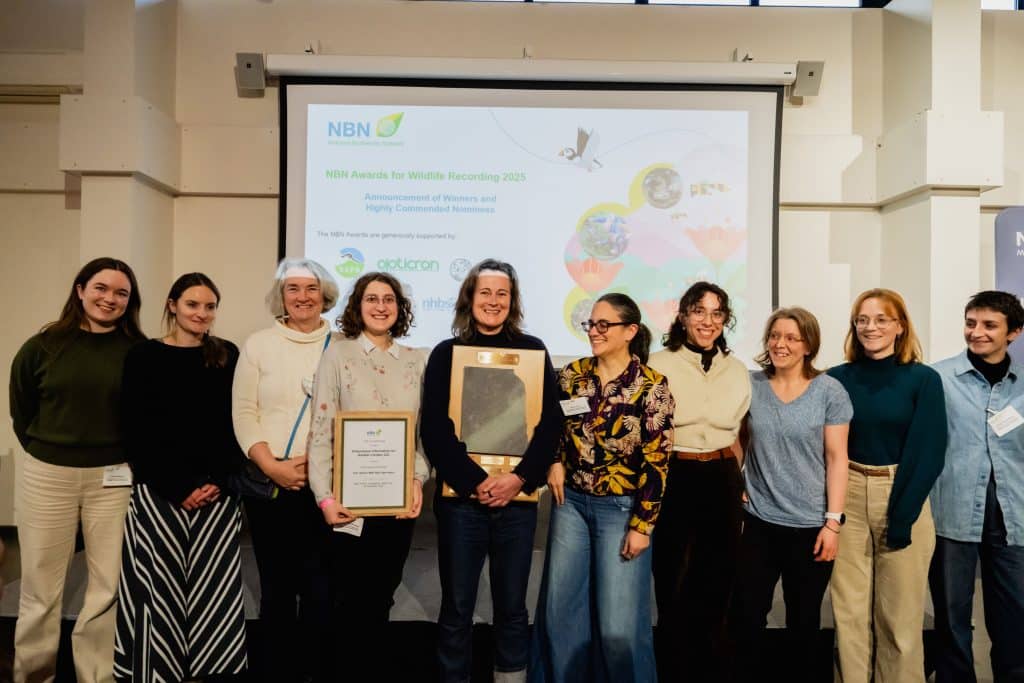
When SLBI asked GiGL to contribute a short review of Rodney Burton’s ‘Flora of the London Area’, we were delighted at the chance to refresh our understanding and love of London flora. Reading the landmark book has also provided a richness of inspiration for new ways of driving standardised recording projects at the scale of the Flora of the London Area.
Rodney Burton – Recorder and Organiser!
The “LNHS began collecting plant records in 1917” begins Rodney Burton’s book. Rodney compiled and utilised data for the publication of what would ultimately be the ‘Flora of the London Area’ (1983) from 1965 to 1976 – though as the LNHS Plant Recorder and Botanical Society for Britain and Ireland (BSBI) Recorder since 1965, he had been prolifically and skilfully recording London’s plants for far longer. Even in today’s 12 million record-strong GiGL species database, for the period of Rodney’s data collection for the Atlas (1965 – 1976), a significant proportion derive from the London Plant Mapping Scheme, as the project came to be known.
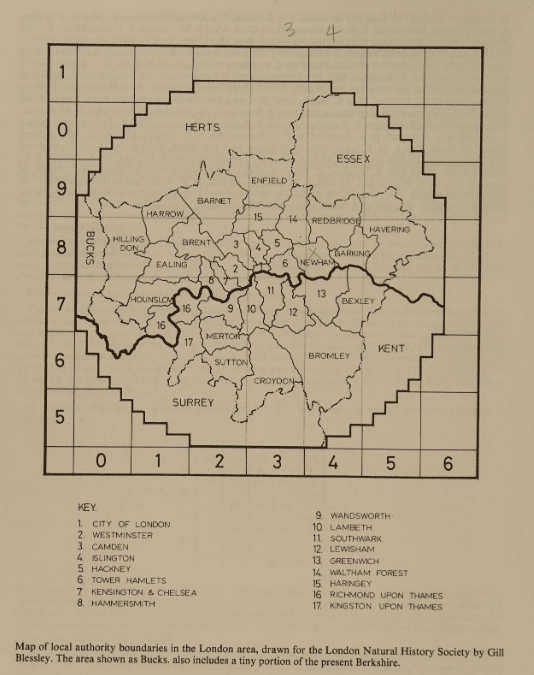
London Plant Mapping Scheme, 1965-76
As detailed in the first chapters of The Flora of the London Area, there are 847 ‘tetrads’, 2km by 2km squares in the 20-mile recording boundary of the London Natural History Society, radiating outward into Hertfordshire, Essex, Kent, Surrey, Buckinghamshire and Middlesex from St Paul’s Cathedral. For anyone intimately involved in plant recording, the prospect of thoroughly recording across 850 tetrads several times a year over many years would have been daunting. Not so for the LNHS:
“The pros and cons of recording by 10km square or 2km square (tetrad) were discussed. The larger unit of which there are roughly 30 in the areas, while satisfactory for recording on a national basis, is scarcely adequate for demonstrating distribution in a restricted area such as ours. For this purpose, the tetrad (~850 in the area) was considered more suitable…“
As Rodney’s introduction goes on:
“the adoption of the smaller unit could be expected to stimulate interest by encouraging members to adopt their personal tetrads… It was felt the work of coordinating the efforts of the contributors should be spread by the appointment of an overall controller assisted by lieutenants responsible for vice counties“
And so began the London Plant Mapping Scheme, manned by dedicated vice county Lieutenants and tetrad foster parents on 1st January 1965, with visits to every area within the tetrad at least three times a year. Recorders would only note new plant species which were encountered, rather than attempt to record a representative sample of all organisms on all trips. This ingenious method helped generate at least some consistent data across all squares and mitigate ‘recorder fatigue’ which could have exacerbated ‘recorder bias’ (where data density becomes patchy across an area due to fluctuations in engagement rather than a reflection of plant populations). By recording only new species, species richness plots can also be generated for the major plant groups recorded by the volunteers – Horsetails, Ferns, Conifers and Flowering Plant species. The figures below the species richness or density plots for each major plan group across the whole of London.
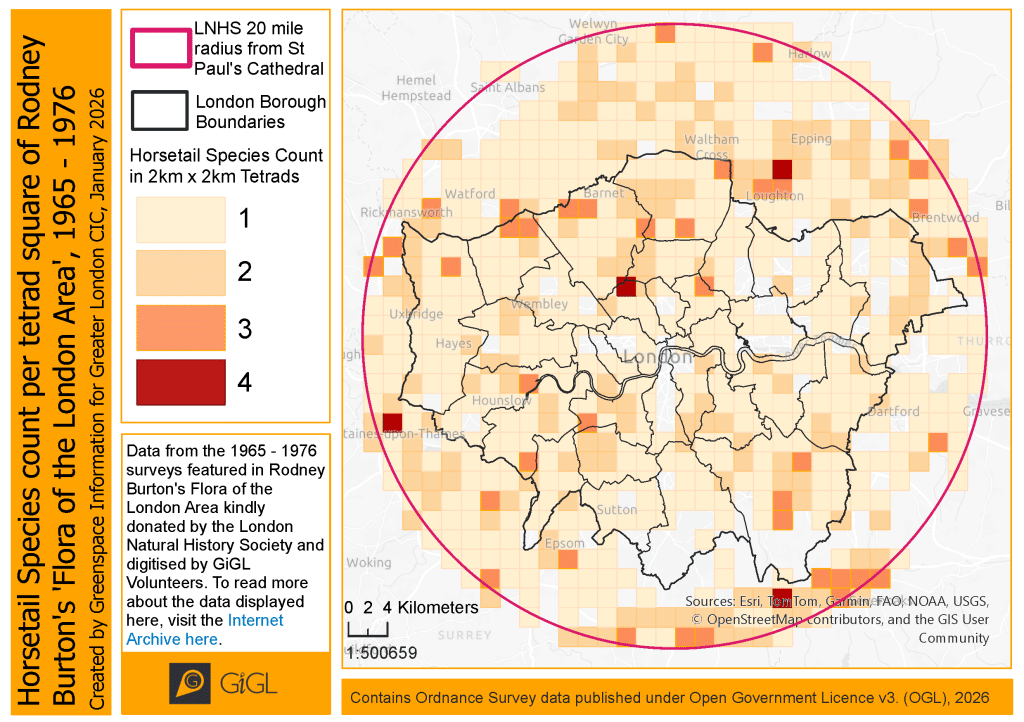
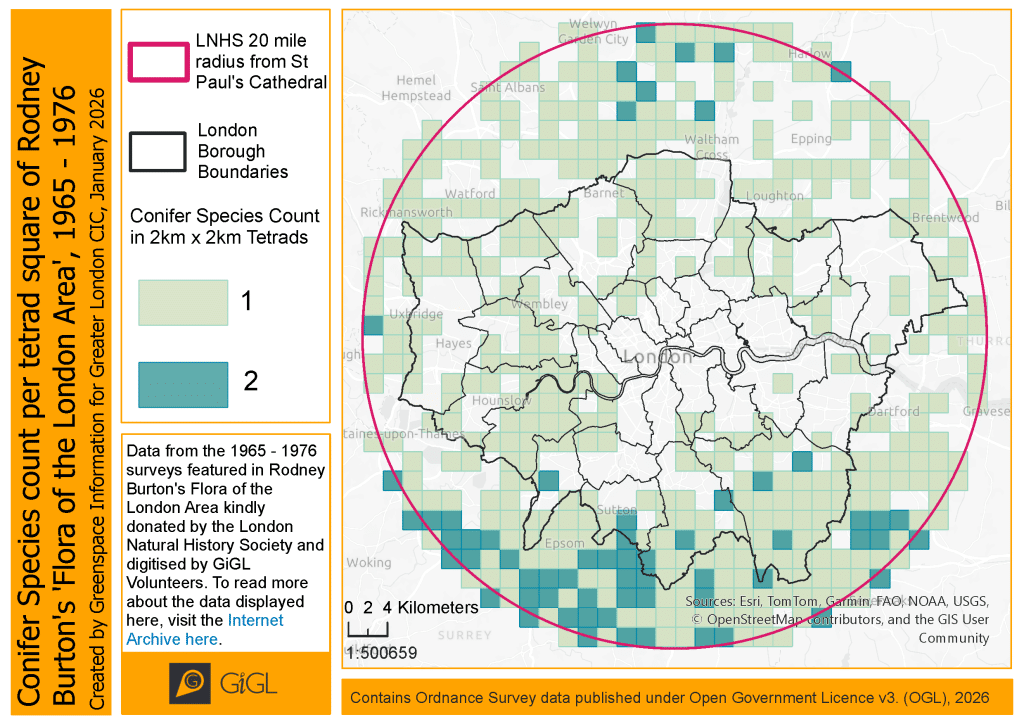
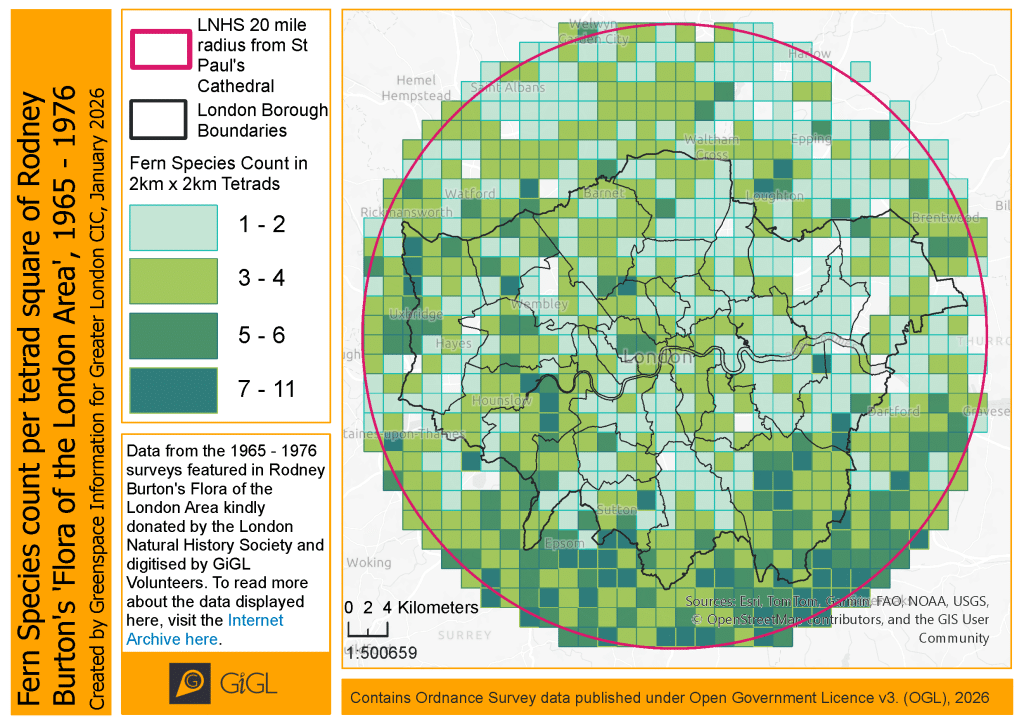
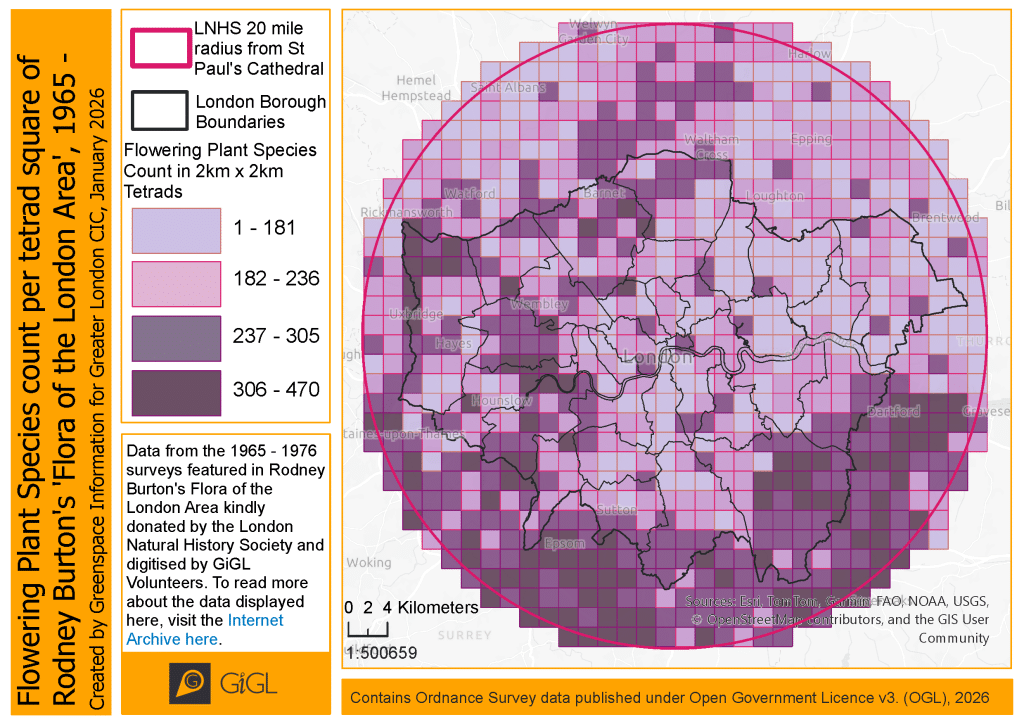
All the 847 squares were visited during the project and the list of species from the 20,000 plus records from the 1965-76 scheme is impressive. Across 733 distinct plant species, the London Plant Mapping Scheme recorded 2 conifer species, 4 horsetail, 15 fern species and 712 flowering plants.
While all squares were visited in the survey programme, the frequency of visitations varied with square accessibility, fluctuating with recorder location and site access needs. Therefore, the distribution of all species will be as affected by these biases as much as, for example, susceptibility to urbanisation, site ‘prettification’ or deforestation.
Ferns are richly recorded across London, particularly in the south and southwest of the programme’s boundary, with the greatest species richness seen outwards into Kent and Surrey. The absence of ferns or low numbers of species in the east of London is noticeable, with boroughs Havering, Redbridge and Barking & Dagenham being the largest regions in London where no fern species were recorded.
Flowering plants show a similar distribution to the ferns, with species density highest in south and northwestern regions, though there are between one and 181 angiosperms reported in every tetrad visited. Flowering plants are by far the most species diverse plant family, but they are generally also preferentially and more easily recorded due to greater flower and leaf morphological diversity. While there appears to be a concentration of species in the outer London boroughs, there is still diversity of species in the centre of London, with several tetrads in the City of London, Westminster, Southwark, Lambeth and others.
Conversely, the distribution of two of the UK’s only three naturalised conifer species found in London – Juniper (Juniperus communis) and Yew (Taxus baccata) page 32 of the Atlas – starkly map to only outer London boroughs and in the tetrads which exist beyond Greater London. Only a single conifer species was recorded in any square north of the River Thames in Greater London.
Flora of the London Area
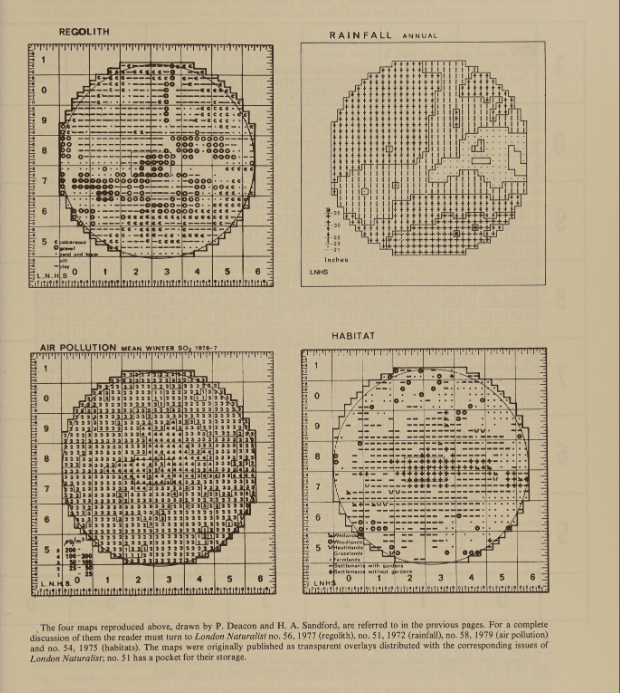
In reading just the first 20 pages of the Flora of the London Area, the reader is blessed with a concise but a comprehensive synopsis of the major biotic and abiotic drivers affecting London’s botany – ranging from the underlying geology of soil (London’s influential ‘regolith’) to the slope of the capital’s hillsides and their exposure to wet and dry weathers, to changes in the use of forested common land to grazed enclosed agricultural landscapes.
Despite the complexity, Rodney also deftly accounted for the fact that there is one single other large factor at play in the mapped distribution of different species – chance! The chance that the plant exists in specific place at a specific time; the chance that a sufficiently skilled botanist might come across it in the correct season for its identification etc. Species distribution analysis is a tricky business…
Modern translation and contemporary use of the data
The contemporary digitisation and incorporation of the records by GiGL and GiGL volunteers (collectively the ‘Data Crunchers’) into the GiGL Species Dataset, was described during the inaugural 2019 London Recorders’ Day, by current LNHS Botany Chair, Mark Spencer as ‘herculean’! If digitising the records of the Flora of the London Area can be described as ‘herculean’, the decade-long recording campaign, its coordination and write-up in Rodney’s Atlas is something altogether Olympian, in the mythological sense.
The Flora of the London Area is a spectacular example of collective, standardised recording – giving both a snapshot into the flora present in London then and provides a robust baseline of data for us to build upon today. The development and future monitoring of the strategic conservation priority plan the London Local Nature Recovery Strategy, did and will widely utilise the data and knowledge contained within the Flora of the London Area. The permeation into the current stock of great London naturalists, helped to formulate the plant species which feature on the 270-plus strong LNRS Species Long and Shortlists.
The survey also forms the basis of good practice for long-term recording projects, mobilising large numbers of skilled volunteers to perform botanical surveys in a devolved network across an area larger than London. With accessible data and a blueprint for repeating the survey, a modern update on Rodney Burtons’ Atlas would be a timely and worthwhile effort. In 2017 the LNHS reported to the Charity Commission that repeating Rodney’s Survey for a renewed Botany of the London Area is the utmost priority. Perhaps Rodney’s work will be renewed once again…
Rodney Burton died peacefully on 26th May 2024. He was a beloved and admired member of the LNHS, BSBI, SLBI and the Wildflower Society, as well as a sharer of knowledge and wisdom to anyone lucky enough to accompany him on a site visit.
Further Information:
You can rent copies of Rodney Burton’s Flora of the London Area from the London Natural History Society library located at the Angela Marmont Centre at the Natural History Museum, through the South London Botanic Institute’s library located in Tulse Hill, or access the full text online by signing up to the Internet Archive.
Other articles from the GiGLer on the LNHS and record digitisation can be here and tickets for London Day of Nature 2026 are on sale and available now!
London Natural History Society: The LNHS traces its roots back to 1858, when the Haggerstone Entomological Society formed. Since then, the society has grown and evolved in scope to foster an appreciation and understanding of London’s wildlife and natural environment, through biological recording. You can join them at their Recorder Field Days and lecture series by visiting: LNHS Activities Schedule
Mark Spencer, Middlesex and LNHS Botany Recorder, Rodney’s modern counterpart was a key figure in creating both the LNRS, as well as other important species lists, like the Axiophyte list and the upcoming Rare Plant Species list.
GiGL would like to thank the London Natural History Society’s Vice County Lieutenants, as listed in the Flora of the London Area, as well as Rodney Burton himself for gathering, sharing and presenting the data beautifully in the Flora of the London Area Atlas.