
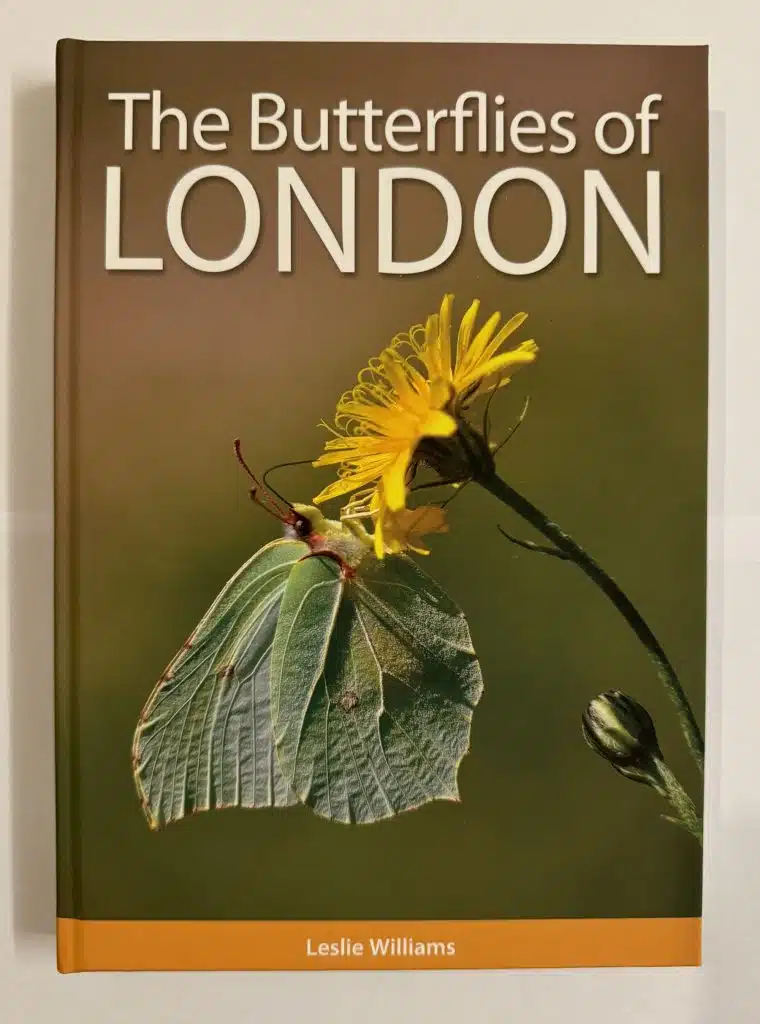
I’m Leslie Williams, a Recorder for butterflies serving in a volunteer role with the London Natural History Society (LNHS). The Society has recently published ‘The Butterflies of London’, a book that maps the distribution of each butterfly species in Greater London. The book includes photographs of each species in their London habitats and basic information on the life cycles and foodplants. Maps of current distributions are displayed and sit alongside maps of species distributions in the early 1980s, so major changes can be viewed at a glance. Together with graphs of the changes in abundance, the book suggests how butterflies can be conserved and encouraged in London.
The LNHS is a charity concerned with recording the wildlife of London and has been doing so for over 100 years. Methods and technologies have changed over the years. The distribution of butterflies was first mapped in the early 1980s; while for more recent decades we also now have abundance data from London’s monitored transects.

The Creation of a New Atlas
For this book the LNHS worked closely with GiGL. The LNHS and GiGL have a long history of collaboration. GiGL holds LNHS data going back to its inception and have worked together on many projects on data mobilisation such as the Masses of Moths project. More recently GiGL have joined forces on the Axiophyte project and Local Nature Recovery Strategy. LNHS are GiGL’s go-to species experts and provide important verification expertise on an annual basis. Verification is the process of checking that records in the GiGL database are likely to be correct, based on their location, timing and identification issues. Any probable errors are highlighted so that the records can be tagged accordingly.
The decision to update the butterfly atlas of the early 1980s was made by the LNHS Council. With over thirty years since the atlas of the early 1980s, some changes were being observed and there were questions arising on whether those changes were local or more widespread across London. Had there been changes since the early 1980s, and what is the current distribution of butterflies in London?
And so, the project commenced during 2015 with trialling the flows of existing records and how best to maximise survey coverage. By 2016 records were being received from a range of existing surveys, plus records from LNHS members and others. Sites with transects, in which butterflies are recorded along a set route, once a week between April and September, provided much information. Although records were also received from residential gardens, there remained large gaps in coverage in urban estates, suburbia, commercial and industrial areas and even in some of the Green Belt areas on the outer edges of London.
The project utilised a grid map of London to frequently update where butterflies were being recorded and that also helped show the areas with few or no records. New recording was focused into those ‘gap’ areas, with visits on weekends or other days. London’s local footpaths, long-distant paths such as the Capital Ring and the above-ground rail stations, provided access into some of the gap areas where there were unrecorded monads (one-kilometre square) and tetrads (two-kilometres square) grid squares.
In good weather, which is when the presence of flying adult butterflies was conspicuous, the various surveying methods made for enjoyable visits. But it did take a time commitment. Thank you to the many people who participated in the recording.
GiGL received all the butterfly data from the identified existing sources and targeted surveys, amounting to more than 141,000 individual records across 314 surveys and transects. It took a mammoth 155 hours to validate and upload these records into the GiGL species database. The next step was to produce the individual species maps for the Atlas. Again, this wasn’t a quick job, taking an amalgamated 23 hours spread over a series of months and many conversations. The maps were important as part of the visual story of how butterflies are faring in London. They contributed to the picture of current distribution and ongoing change.


As with any book, the writing of the text, preparation of graphs and photographs took time. The project made an early decision that as the book was about London, the photographs of butterfly species should be from within Greater London. That was challenging for some species but in the published book, that was achieved with just a few exceptions. The text was checked several times by volunteers from the LNHS. Not least, there were discussions with the publisher and their work on the layout design.
Atlas Insights
Are there insights from the survey? Certainly, though please see the book, as that has far more information. Unfortunately, some species have declined in distribution and/or abundance since the early 1980s. But there have been gains too with successive expansions within areas of London of the Speckled Wood, Gatekeeper, Marbled White and the Ringlet. The reason for these changes is less than clear-cut. Some have expanded their ranges in south-east England, though that doesn’t necessarily explain the changes in London. And while those four species have expanded their range, another grassland species, the Wall declined to practical extinction in London, though a few individuals have been seen near to the Thames and the edges of London during recent years. The increased range of the Brown Argus in London is thought to have been a response to climate change, but it appears also to have shifted in its larval foodplant preferences. The Brown Hairstreak has spread rapidly in London during the past decade.

The ‘habitat specialist’ butterflies have particular needs and are often confined to their habitats, for example chalk grassland, so there is an important role for nature reserves and management of connected habitat elsewhere.
There is reason for some optimism. The survey found that there are over twenty species, that with appropriate habitat, can be encouraged almost anywhere in London. Many of those ‘habitat generalists’ include species that use woodland, woodland edge or grasslands. Grasslands are best when they are enabled to grow during the spring and summer without frequent mowing. Cutting could be once a year, which helps particularly for those species that lay their eggs on grasses. Where grasslands are cut a few times a year, that may allow some plants to flower in between the cuts, and to provide nectar for adult butterflies.
London has greenspaces with potential for the mixes of woodland, hedges and grasslands in parks and even in private gardens, for the benefit of butterflies, wildlife and people.

Where next for butterfly recording and conservation in London?
- There remain gaps in our knowledge of the distribution of some species, so continue recording and taking part in schemes run by Butterfly Conservation, GiGL and the LNHS.
- Join one of the butterfly transect site teams.
- Help to restore, create and manage habitat for butterflies in gardens, local parks and other greenspaces in London.
One last success story. In the early 1980s the Brimstone was absent from large swathes of London north of the Thames. For egg laying, the Brimstone relies on one or two species of Buckthorn. A project to plant Alder Buckthorn in gardens and parks rapidly attracted Brimstones, which in turn spread locally to the next nearest Buckthorn bushes. And now the Brimstone is a widespread sight in spring throughout most of London.
The Butterflies of London is available from www.naturebureau.co.uk/bookshop to order or at other booksellers. ISBN 978-1-913994-17-4 Hardback 240 x 170 mm 256pp Full colour throughout. Published price £29.95 + £4.50 p&p.
