
This site includes three ponds at Hall Farm that are relics of an old moat, as well as an adjacent churchyard and horse-paddock that are notable for their species-rich grassland.
Local Wildlife Site
Accessible Sites of Importance for Nature Conservation
Hall Farm moat, paddock and St Mary Magdalene Churchyard, North Ockenden
Borough: Havering
Grade: Borough Grade II
Access: Free public access (part of site)
Area: 3 ha
Description
Wildlife
The smallest of Hall Farm's ponds is surrounded by planted trees and shrubs and contains abundant curled pondweed. The central pond is used for angling and supports species such as purple loosestrife, great reedmace and amphibious bistort around the edges. Scattered crack willow, oak and ash trees grow on the banks. The banks are sandy and in places contain the burrows of solitary wasps, with similar activity occurring near the pond edge in the paddock. The southern pond is also used for angling and again has patches of emergent vegetation around the margins. The banks are mainly grassy but with frequent shrubs and trees, especially on the northern bank, where a hedge has also been planted. The churchyard contains burnet saxifrage and grey sedge. Common dog-violet and sweet violet are abundant along the northern edge. A fine avenue of lime trees grows along the path in the churchyard. St Cedd's Well, a grotto located in a separate fenced area to the south-west, is housed in a small building. This and the church are both potential bat roosts. The paddock has abundant lady's bedstraw, common knapweed, bird's-foot-trefoil and meadow buttercup. There are smaller amounts of musk mallow and bugloss, the latter very rare in London. The churchyard is mown very short and may therefore contain other species of interest.Facilities
Fishing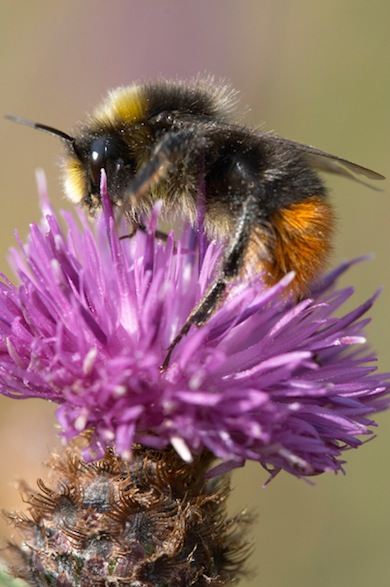
Bumblebee on thistlehead © Jason Gallier
Feedback
Have a question or a comment for this site, or notice anything missing or out of date? Please contact us.