
The re-profiling of the River Quaggy provides the main conservation interest in Chinbrook Meadows, since it has created a mosaic of habitat types and has reconnected the river to its floodplain. The river runs through the centre of the site. The southern area contains a marsh, rough grassland and several large native and ornamental trees. This part of the site is less used. The northern area contains mature trees and native woodland to the west, and a large patch of grassland to the east.
Local Wildlife Site
Accessible Sites of Importance for Nature Conservation
River Quaggy at Chinbrook Meadows
Borough: Lewisham
Grade: Borough
Access: Free public access (all/most of site)
Area: 11.06 ha
Description
Wildlife
Wetland plants present in the site include water plantain, fool's watercress, pendulous sedge, great willowherb, reed sweet-grass, flag iris and water mint. The southern marshy area contains abundant sedge and lesser reedmace. A pond in the northern area supports common spike-rush, fool's water-cress and brooklime. The grassland areas contain species tolerant of a high water table, including crested dog's tail, wild carrot, teasel, ox-eye daisy, salad burnet and perennial cornflower. There are a few plants of butterbur, which is uncommon in London. There is a variety of planted trees and shrubs (mostly wetland species) such as alder and willow. The river and wetlands support a variety of invertebrates (especially spiders, dragonflies and damselflies) and fish. The variety of habitats will also attract foraging birds, including the kingfisher. The mature trees in the north-western area include oak and crack willow, containing features that could be used by roosting bats. The woodland is composed of oak, sycamore, holly and bramble. The common grasses found within the large patch of grassland include cow parsley, common nettle and ribwort plantain. Mature tree species found amongst the grassland include pedunculated oak, hybrid black poplar, Lombardy poplar, white willow, yew, plum and hawthorn. The grassland composition in the southern area changes to common bent dominated, along with red fescue, common sorrel and bird's-foot trefoil. Gorse and greater stitchwort flank the southern boundary. The southern part supports a rich birdlife including jay, chiffchaff, chaffinch, long-tailed tit, green woodpecker and house sparrow.Facilities
Information; car parking with disabled access; toilet including disabled facilities; play area; café; sports amenities. The footpath forms part of the South-east London Green Chain Walk and the Capital Ring. There are on-site park keepers.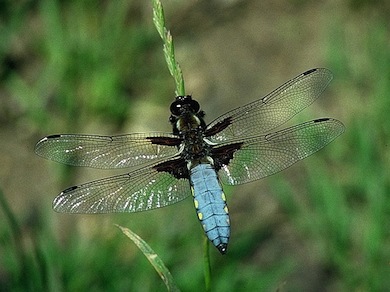
Broad-bodied chaser © Stephen Frank
Feedback
Have a question or a comment for this site, or notice anything missing or out of date? Please contact us.