
The consultation on the Draft London Plan 2026 has now closed. GiGL submitted a response highlighting the importance of ecological data in supporting effective planning decisions and helping deliver the Plan’s ambitions for nature recovery.
During the consultation, we reached out to our community and professional networks with our key recommendations, asking them to support and advocate for the role of ecological evidence within their own responses. Many of you did exactly that!
Whether by sharing our messages or referencing our recommendations in responses, our community demonstrated the growing strength of the GiGL network. From social media followers and Service Level Agreement partners to ecologists and community groups, we continue to build a network of ambassadors for ecological evidence.
Thank you to everyone who supported our response and continues to support GiGL’s work.
While the consultation process is over, the issues raised remain just as relevant. The final London Plan is still being shaped, but the need for robust evidence extends beyond a single policy document. Every planning application, conservation project, management plan or funding decision presents an opportunity to ensure nature is properly understood and considered.
GiGL’s evidence base supports planners, ecologists, developers, researchers, local authorities, community groups and environmental organisations in making informed decisions. In turn, there are many ways our stakeholders can support GiGL’s mission.
Our London Plan factsheet may have been developed in response to the consultation, but its recommendations are relevant to anyone involved in shaping, managing or protecting London’s environment.
Five ways you can champion nature and evidence
Promote the use of the most up-to-date ecological evidence, especially in the planning process
Whether reviewing development proposals, preparing ecological assessments, designing projects or influencing policy, access to current ecological data helps ensure better outcomes for both people and nature.
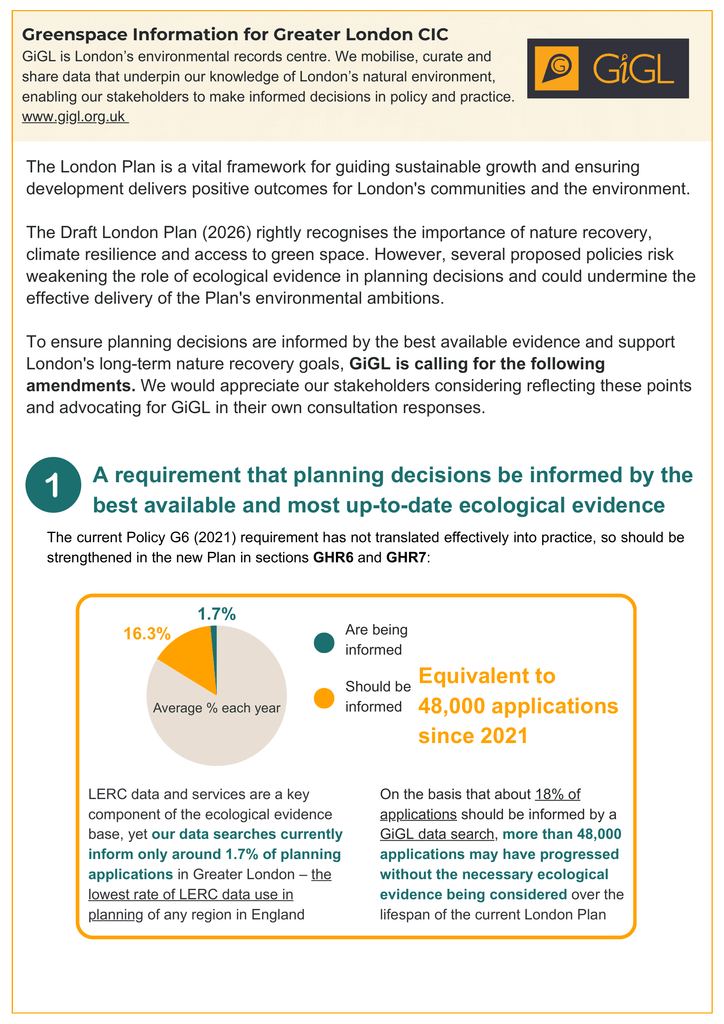
Only around 1.7% of planning applications currently use GiGL data, suggesting that about 48,000 planning applications may have progressed in the lifespan of the current 2021 London plan without drawing on the best available ecological evidence available.

As ambassadors, our community can encourage the routine use of environmental data in planning. Local authorities can include requirements for a data search in validation checklists or Local Plans, while community members concerned about a planning application can check whether a GiGL data search report has been consulted. They can also request a report from us to compare against the information used in the application.
Look beyond strategic maps and support local evidence
Strategic tools such as the London Green Infrastructure Framework (LGIF) and Local Nature Recovery Strategy (LNRS) are valuable resources, but they cannot capture the full picture.
Biodiversity data change constantly as new surveys are undertaken, habitats are restored, or designated sites are reviewed. Since publication of the LNRS (March 2026), GiGL’s species database has grown by more than 244,000 records, and 10 SINC reviews are happening or have been completed in London which will mean the LNRS layers will soon be out of date.
This importance of maintaining current ecological evidence is reflected in the LNRS itself. The Statement of Biodiversity Priorities recommends that biodiversity monitoring and the sharing of ecological data should be a requirement of funding. It also states that boroughs and developers should use GiGL’s data search services and share habitat and species records generated through surveys.
Similarly at a national level, new Government guidance on Local Sites and nature conservation (August 2026) highlights the important role that Local Environmental Records Centres (LERCs) play in collating, managing and mobilising data for local sites. The guidance also encourages data use and sharing, further highlighting the need for current ecological evidence alongside strategic planning tools.
Remember that important nature exists all over London!
Nature does not stop at the boundary of a designated site.
Approximately 15% of priority habitat sits outside London’s Sites of Importance for Nature Conservation (SINCs), while significant proportions of protected and notable species records also occur beyond these boundaries.
This is why GiGL developed the Biodiversity Hotspots for Planning map, helping users identify areas where valuable nature may not be immediately visible.
As an ambassador, help challenge assumptions that only protected sites matter. Nature can be found across parks, waterways, road verges, housing estates, brownfield land and countless other spaces throughout London.

Contribute data back to the evidence base
Strong evidence depends on continued contributions – meaning a good data flow for London.
Ecological surveys, habitat assessments, species monitoring and conservation projects all generate valuable information that can help inform future decisions. Yet less than 0.02% of records within GiGL’s species database have been supplied through the planning process.
Don’t let valuable data be gathered once and never used again, consider how it can be shared to strengthen London’s collective evidence base.
Help raise awareness of invasive non-native species
Invasive non-native species continue to place a huge pressure on London’s ecosystems, with nearly 223,000 associated records held within the GiGL database.
Improving awareness, recording occurrences and considering invasive species as part of project planning can all contribute towards better biodiversity outcomes.
The London Invasive Species Initiative (LISI) is currently updating guidelines to help effectively consider, monitor and take action on invasives. The GB Non-Native Species Secretariat also provide ample resources and information on this subject.
Looking ahead
The London Plan consultation may have come to a close, but the conversation around ecological evidence and the value of London’s nature must continue.
GiGL will continue to work with our range of stakeholders to make that possible. We know we cannot do it alone – every person who champions GiGL, shares data and advocates for nature becomes part of a growing network of GiGL ambassadors helping to create a better-informed future for London’s environment!