
SINC Management Resources
Effective management of Sites of Importance for Nature Conservation (SINCs) is crucial for protecting biodiversity, enhancing ecological connectivity, and supporting Biodiversity Net Gain. Aligned with the National Planning Policy Framework, SINCs should be safeguarded as part of wider ecological networks, with clear targets for habitat conservation, restoration, and species recovery. Collaboration with eNGOs, local authorities, and conservation groups ensures strategic management and measurable biodiversity improvements.
Organisations involved in SINC management:
Local authorities (33, including the City of London Corporation)
Charities & Environmental NGOs
Friends of Groups
Utility & transport companies
Religious organisations
Sport clubs (e.g. golf)
Private companies
Partnerships and organisations involved in supporting managers and management objectives:
Managing a SINC
1. SINC Designation & Protection
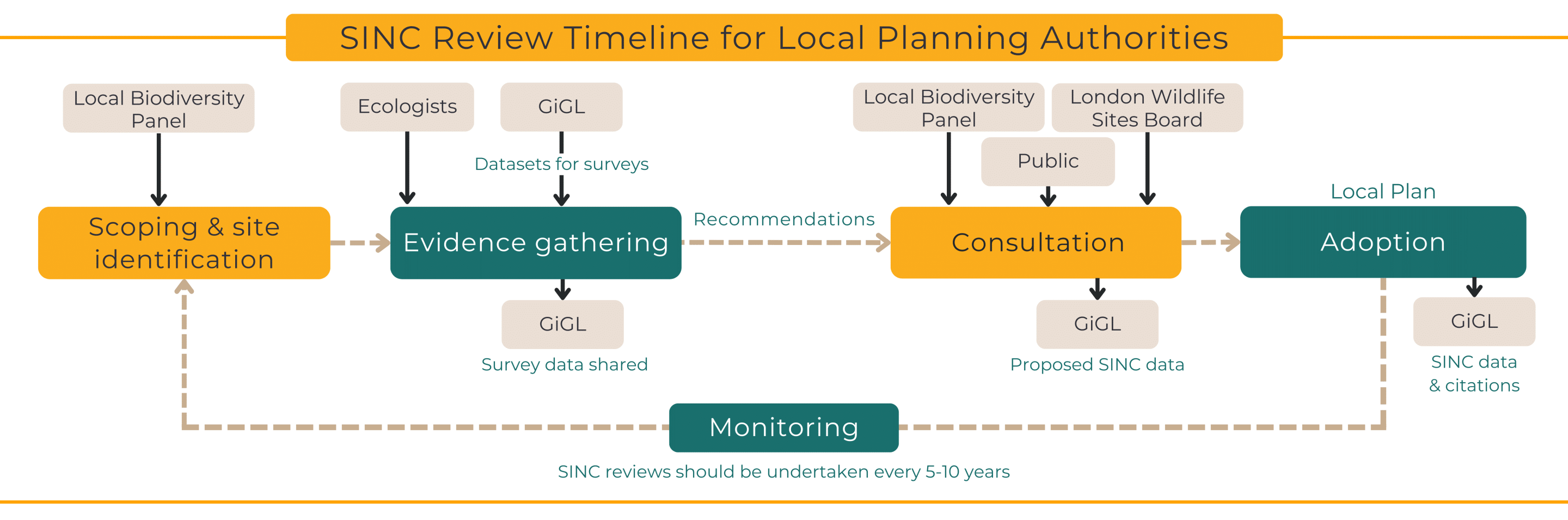
Local Plans are key to the identification and protection of SINCs. Local Planning Authorities (LPAs) are responsible for undertaking SINC reviews, these align with the Local Plan process and SINCs are officially adopted when the Local Plan is published.
SINC protection in legislation, policy & strategy
National Planning Policy Framework 2024
Chapter 15: Conserving and enhancing the natural environment.
London Plan 2021
Chapter 8: Green Infrastructure. Specifically, Policy G6 Biodiversity and access to nature.
London Environment Strategy (LES) 2018
Appendix 5 provides guidance on the SINC selection, extracted from the previous GLA SINC advice note (2019).
Chapter 5 ‘Green Infrastructure’ proposal 5.2 1a addresses SINCs and London Plan policies relating to SINCs recognising biodiversity and access priorities.
Objective 5.1 and 5.2 provide two quantified objectives relating to the role of the SINC network in protecting priority habitats.
Environment Act 2021
Part 1 Environmental governance, Chapter 1 Improving the natural environment.
Part 6 Nature and biodiversity (BNG & LNRS).
London’s Local Nature Recovery Strategy (LNRS)
Published in 2026, it is recommended that boroughs use the LNRS to align Local Nature Recovery Plans in accordance with individual Local Plan cycles.
Natural Environment & Rural Communities (NERC) Act 2006
Part 3 Wildlife etc., Section 41 Biodiversity lists and action (England) & Section 40 Duty to conserve and enhance.
Wildlife & Countryside Act 1981
Chapter 8: Informs the assessment of core criteria for SINC designation.
The Conservation of Habitats and Species Regulations 2017
Outlines the Regulations affording internationally recognised protection to rare habitats and species at the European level. Where such designated sites overlie SINCs, greater protection is afforded in the development planning system.
National Parks and Access to the Countryside Act 1949
Informs statutory instruments for Sites of Special Scientific Interest (SSSIs) designations, and of National and Local Nature Reserves (NNRs and LNRs, respectively), which, when overlapping with SINCs, provide greater protection in the planning process.
London’s Green Infrastructure Framework (LGIF)
A London-wide strategic evidence tool designed to support the planning, delivery and long-term management of green infrastructure. The LGIF consolidates key data into resources to help guide decisions on where and how green infrastructure can deliver the greatest social and environmental value.
Published in March 2026, the LGIF replaces the 2018 GI Focus Map and the 2012 All-London Green Grid.
Designation process
London Wildlife Sites Board
The London Wildlife Sites Board (LWSB) is an advisory body providing a range of expertise and experience. Their main role to provide advice on the review process and they should be consulted on SINC reviews and proposed changes. They can also advise on management planning and delivery, and ensure consistency and compliance with various policy frameworks.
London Wildlife Sites Board
2. Information for Sites
To manage a SINC effectively, managers must first know what is present by accessing the relevant data for SINCs, other site designations, habitats, and species. These are available from GiGL, but other datasets may come in handy for management planning, such as Environment Agency flood risk data.
GiGL can also enhance management plans through detailed analysis and modelling, helping identify opportunities for habitat restoration, connectivity and access for locals.
Accessing site & species information
GiGL is the official custodian of information on London’s SINCs – including their citations and boundary information. GiGL works with all LPAs to maintain this information, whether they are partners or not, although some LPAs may choose to use their own datasets. Additionally, GiGL stewards a wealth of other datasets covering information on London’s natural environment, many of which can help with SINC management.
How to access data?
Accessing GiGL Data | SINC Resource Hub
What data do GiGL hold?
GiGL Data Holdings
GiGL Data Guide
Recommended datasets for SINC reviews:
Non-statutory SINCs
Statutory designated sites – e.g. SSSIs and RAMSAR sites.
Geodiversity sites
Designated species
Areas of Deficiency in Access to Nature
Habitat Suitability Modelling
Habitats
Other datasets
Note that the below are open government licence datasets and can therefore be shared via GiGL to save extra steps and time.
Priority Habitat Inventory | Natural England
Ancient Woodland Inventory | Natural England
Flood Risk | Environment Agency
Climate Risk Mapping | GLA
London Tree Map | GLA
Additional GiGL services to aid management
Areas of Deficiency predictive modelling
Investigate how AoD and access could be improved for sites.
Habitat Suitability Modelling
Identify suitable areas for the creation of priority habitats.
Ecological Network Mapping
Identify the current ecological networks and find opportunities to improve habitat size, quality and connectivity.
Woodland Opportunity Mapping
Find the highest scoring areas are those with the most potential for woodland creation.
Important habitats & species
Species designations
A list of legal designations affording species protections, as well as other notable (non-legal) designations that are relevant to review criteria and attributed in GiGL’s species dataset.
Species Lists – follow this link to access the below resources:
- Greater London and Middlesex Axiophyte List: A list of plant species which are indicators of habitats of interest for nature conservation.
- London’s LNRS Focus Species Longlist: Created as part of the steps to developing the capital’s Local Nature Recovery Strategy (LNRS). The spreadsheet includes information on the primary habitat and practical measures deemed important for the recovery of each focus species.
- London Invasive Species: Invasive non-native species that are cause for concern and a potential threat to the value of London’s natural environment.
- London Priority Species: London’s priority species are those species we share our city with that are national priorities for conservation and those that are believed to be declining in London or beyond.
London’s Biodiversity Action Plan
The archived London Priority Species and Habitat Action Plans created by the London Biodiversity Partnership (now dissolved) can also be a useful resource, though some of the information may be outdated.
3. Management Tools & Support
To take management beyond protection alone, a range of tools and guides can be accessed by mangers. These have been created by a range of organisations over time, all with expertise and experience in practical conservation and management planning.
Funding support
Reduced public sector budgets present challenges in funding management, making it essential to explore alternative approaches and secure new funding streams. This could involve shifting management responsibilities to other organisations, such as local community groups, or integrating management goals with LPAs’ statutory duties to unlock co-funding opportunities.
Funding | Parks for London
Guidance & toolkits
Rewilding in London
London Rewilding Taskforce
Green space quality manual | Parks for London
Urban greening and BNG design guide | London Wildlife Trust
Tree and woodland strategy toolkit for LAs
Woodland condition self-assessment toolkit | LWT
Oak Processionary Moth: A toolkit for LAs | The Tree Council
Monitoring & reporting resources
Data feedback:
If surveys are being conducted or habitat restoration is taking place as part of management efforts, it is important to share this information with GiGL. This ensures the data is incorporated into London-wide datasets, enhancing the vital data flow for London and ensuring the information can be shared to nearby initiatives and considered in planning. Follow GiGL’s data standard guidance to ensure generated data can be easily incorporated:
GiGL Survey Data Standards Guidance
Species monitoring:
Recording with GiGL improves species data for local sites and offers a great way to engage communities. Site managers can embed monitoring in events, guided walks, youth nature clubs, or ranger-led surveys, using apps, spreadsheets or webforms to capture sightings on the spot. Discover the recording methods below and get in touch with a member of our Community Team to discuss how GiGL can support further.
Submit 1-20 Wildlife Records
Regularly Record – using GiGL’s recording spreadsheet
Recording Apps
Consider survey seasonality when conducting species or habitat monitoring. Consult experts for advice or use survey calendars:
LUC’s Ecology Survey Calendar
Local Sites in positive conservation management
Defra annually requests a report from Local Authorities on Local Sites in positive conservation management. This is not legally mandatory but is strongly encouraged as part of local and national biodiversity monitoring. Find out more here:
Local Sites in positive conservation management in England
Additional Support & Resources
Further links & articles:
Parks, green spaces and biodiversity | London City Hall
Spaces Wild | London Wildlife Trust
Areas of deficiency explained | GiGLer Newsletter
The importance of high quality natural spaces for well-being by Dr Sarah Knight | GiGLer Newsletter
Accessing Wildspace | GiGLer Newsletter
Updating GiGL’s Areas of Deficiency | GiGLer Newsletter
Historic Environment Considerations for London’s LNRS
Glossary
Explore key terms, acronyms, other land designations, and policies commonly referenced on the Hub, with clear explanations for quick understanding.