
Telegraph Hill Park is divided into two by Kitto Road. It has a varied, undulating terrain. The lower (northern) part rises quite steeply from north to south, while the upper (southern) section slopes down towards the west. There are particularly fine views across London from the southern section. Both sections contain a good variety of trees, both native and exotic, many of which date back to the original landscaping. Lewisham Health Walks project uses this site – a Walking the Way to Health (WHI) scheme; see link for details.
Local Wildlife Site
Accessible Sites of Importance for Nature Conservation
Telegraph Hill Park
Borough: Lewisham
Grade: Local
Access: Free public access (all/most of site)
Area: 4.15 ha
Description
Wildlife
The northern section has recently been re-landscaped, with a new pond fringed with native and exotic wetland plants. A good range of species have established including pendulous sedge, flowering rush, water lilies, winter heliotrope and figwort. Surrounding the pond are tall herbs including red campion, alexanders and cow parsley, and a newly planted hawthorn. Adjacent grassland is managed less intensively and allowed to flower. This area is likely to be of value to dragonflies, damselflies and other insects, and the aquatic habitat for common amphibians. This park has many large trees. Among the more notable trees are a surprising number of hornbeams; while a common part of ancient woods in the area, hornbeam is not often found planted in parks. The exotic trees include fine specimens of Indian bean-tree, narrow-leaved ash, honey locust and maidenhair tree. There are also many London plane and lime. Of particular interest are a number of Fontainebleau service-trees, a species only occasionally planted elsewhere in London. Both sections of the park contain densely planted shrubberies, particularly at the edges. These support a good range of common birds, including the declining song thrush.Facilities
Information; toilets, including disabled; sports amenities; play area; refreshments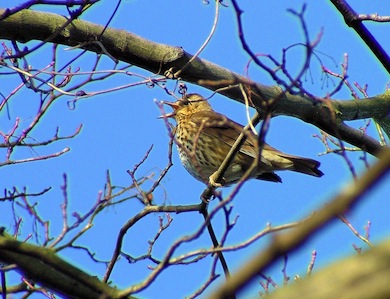
A singing Song thrush © Susy Hogarth
Feedback
Have a question or a comment for this site, or notice anything missing or out of date? Please contact us.